 020 7898 0500
Financial year-end is a tricky period for UK SMEs, but having an FX checklist can help.
Last updated: 20 February 2026
In all the mayhem around key reporting dates, many UK SMEs fail to tick off jobs and reduce risk with a financial year-end FX checklist.
Having a clear picture of the unique risks your business fails, as well as the necessary strategies to protect your profits and cashflow, is integral to long-term stability. But doing so feels out of reach to many small businesses, which suffer from common stumbling blocks such as outdated technology, limited resources and limited currency specialisation.
In 2026, ending the financial year the right way requires moving beyond anecdotal calculations to accounting-grade valuations. Key steps include quantifying EBITDA leaks from unhedged exposures, auditing refund volatility in the travel sector and eliminating ‘key person’ risk by switching out manual Excel spreadsheets for automated treasury tools like SmartHedge PRO.
- Year-end stress testing
- Accounting-standard valuations
- Overcoming spreadsheets at financial year-end
- Why treasury teams are switching to SmartHedge PRO
- Frequently asked questions
Year-end stress testing
Executive boards demand detailed reports that capture the full impact of foreign exchange volatility. Currency markets move faster than ever, threatening to lay waste of carefully planned budget rates.
The key question is how a 5-10% movement in the GBP/USD or GBP/USD rate (the kind of movement we saw in 2025) impact your profits? For some UK businesses, that volatility can take on an added layer across the supply chain. It is vital to consider these scenarios and stress test all your positions to maintain long-term resilience.
Take a look at just how much the pound moved against the US dollar last year. Consider, as well, the likelihood that this trend could easily repeat itself in 2026. When mapped against your budget for the entire year, it’s easy to see why stress testing is more vital than ever for UK SMEs.
GBP/USD: 2025
Accounting-standard valuations
Audit and regulatory requirements have become more and stringent with every passing year. Even small British companies are now faced with pretty onerous box-ticking exercises. A lot of these require tools they simply don’t have (more on that later).
For business that use multiple counterparties to book FX contracts, it is incredibly hard to get a clear snapshot of your cashflow. With varying credit facility headroom, keeping track of your valuations becomes a time-consuming chore.
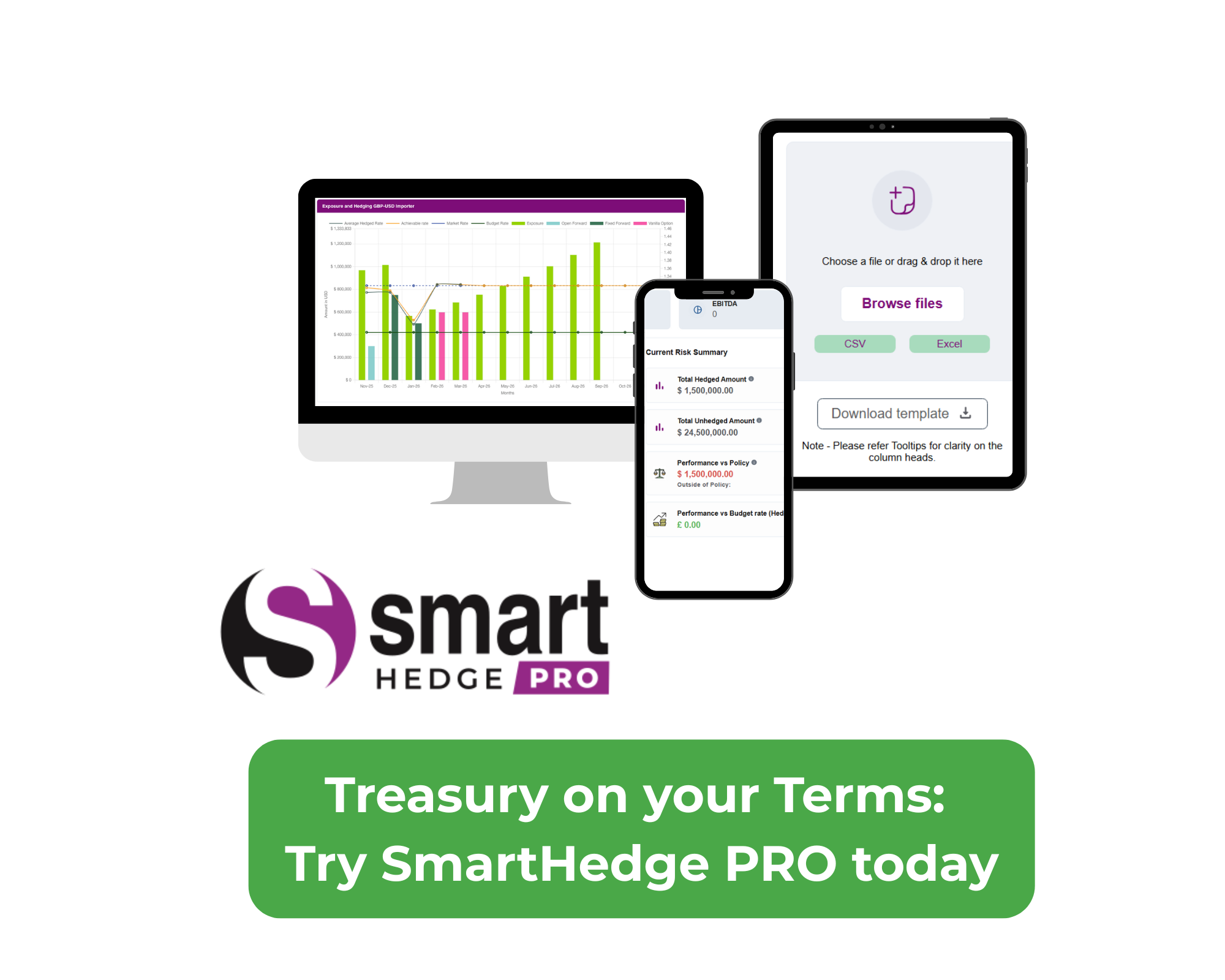
That’s why having a single source of truth across all exposures and counterparties is essential. Comprehensive treasury solutions like SmartHedge PRO can help deliver board-ready reports with one click of a button. With all your information stored in intuitive dashboards, you’ll never have to worry about keeping track of cashflow in 2026. You can see SmartHedge PRO in action by clicking through the interactive demo below.
Overcoming spreadsheets at financial year-end
Outdated, generic software applications such as Microsoft Excel might seem like the simplest way to manage valuations at year-end. After all, they often come installed on many office computers and are understood and used across most businesses.
However, relying on spreadsheets at financial year-end opens your bottom line up to several avoidable risks. Chief among these is the risk of human error. It only takes one small mistake – a missed cell, an extra zero or a broken formula – to break the entire spreadsheet.
These spreadsheets can be sprawling, unwieldy beasts. They are frequently controlled by just one or two key stakeholders; controls for when those individuals take annual leave or are absent for other reasons are seldom well thought out.
To reduce the risk of this, businesses require central depositories of live and accurate information.
Why treasury teams are switching to SmartHedge PRO
Increasingly complex requirements at financial year-end require dedicated solutions. Relying on spreadsheets to map cashflow and valuations across counterparties is no longer viable in 2026.
Treasury professionals use SmartHedge PRO to prepare for the end of the financial year, pulling detailed reports that provide executive-ready insights.
Click here for an exclusive look at the platform and to protect your profits at financial year-end.
Frequently Asked Questions
What is a financial year-end FX checklist?
A financial year-end FX checklist is a strategic document used by UK SMEs to ensure all currency exposures are identified, quantified, and mitigated before the reporting period closes. It typically includes steps to verify outstanding contracts, assess current budget performance, and prepare accounting-grade valuations for executive boards.
Why is stress testing currency risk important for UK SMEs?
Stress testing allows businesses to model the potential impact of hypothetical market shocks, such as a 5-10% movement in GBP/USD or GBP/EUR rates. By simulating these “what-if” scenarios, firms can identify vulnerabilities in their profit margins and cashflow before they become actual losses, ensuring long-term financial resilience.
What is key person risk in treasury management?
Key person risk occurs when a business relies on an individual to manage complex currency valuations and reporting. If that individual is absent, the business loses its ability to accurately track risk, increasing the likelihood of human error, broken formulas, and missed deadlines during critical year-end periods.
How does SmartHedge PRO improve year-end reporting compared to Excel?
Unlike static spreadsheets, SmartHedge PRO provides a single source of truth by pulling live mark-to-market data and consolidating FX contracts across multiple counterparties into one dashboard. It automates the generation of board-ready reports, eliminates manual data entry errors and allows for instant scenario modelling, saving treasury teams hours of manual work.